
Tactile tiles, buy from a warehouse - polyurethane, polymer sand, ceramic - low price in UAH: pickup, delivery, availability

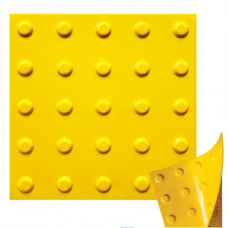
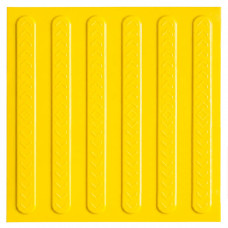
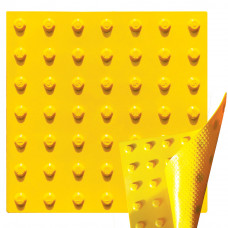
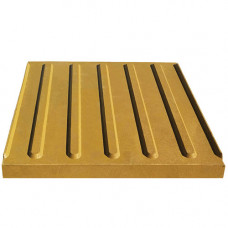


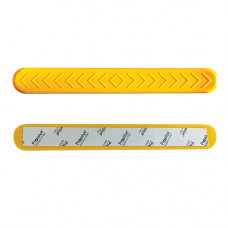
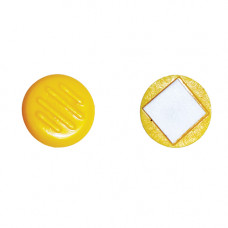
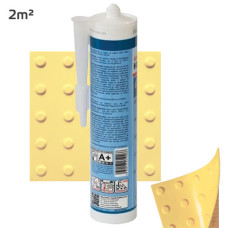
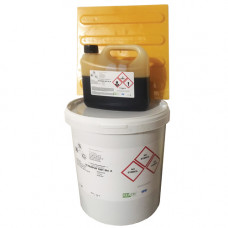
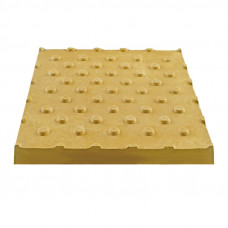
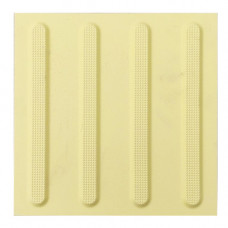

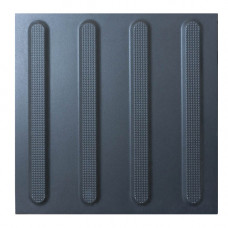
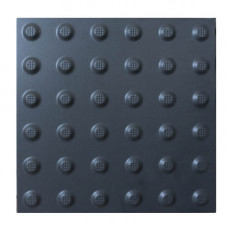

The tactile tile is a floor indicator of direction or change of movement that helps people with visual impairments to navigate in space.
Tactile tiles - what types are there?
Tactile tiles are made from different materials that allow you to maintain a tactile surface over time and are minimally prone to wear and tear. The main types of tactile floor signs:
- polyurethane tactile tiles - for indoor and outdoor use
- polymer sand tactile tiles - outdoor use
- ceramic tactile tiles - used both indoors and outdoors
- concrete tactile tiles - outdoor use.
What do the dots and stripes on the tactile tiles mean?
tactile tile with stripes - used as a direction indicator
tactile tiles with dots in a linear order - as a notification of a change in the direction of movement, the beginning of steps, exit to the carriageway. Information about the need to stop - there is an obstacle ahead
a tactile tile with dots on a diagonal indicates that there is an insurmountable obstacle ahead and there is no further passage.
Why are the tactile tiles yellow?
Often we are asked to change the color of the tactile tiles and are outraged that in some places the yellow color is inappropriate. So why are the tactile tiles yellow? Yellow is the physiologically first color that the human eye recognizes, and yellow is the last color from the entire spectrum of colors that is recognized by a person with loss of vision. That is why it is precisely the yellow color that is so widespread. It is the yellow tactile tile that provides real help for people with low vision.
How does concrete tactile tile differ from polymer sand?
The main difference is in the composition of the manufacture and the method of production.
Concrete tactile tiles are a mixture of sand, cement and water. In the production of concrete tactile tactile tiles, the finished mixture is poured into molds, where the concrete hardens in a given shape. When producing concrete tactile tiles, it is important to use high quality cement to avoid resolution of the tactile surface.
Polymer sandy tactile tiles are a mixture of polymers with sand. Polymer sandy tactile tiles are produced at high temperatures under high pressure. Such a tactile tile has high strength, the ability to withstand heavy loads and temperature drops. It does not crumble or degrade over time. At the same time, polymer sandy tactile tiles have a lower price.
Which tactile tile to choose?
The choice of tactile tiles depends on the place of use. Consider the options where the tactile tiles can be placed
Option 1: indoors, where there is already a floor.
Indoors, where there is already a floor, an overlay polyurethane tactile tile is easy to install and practical. Polyurethane tactile tiles are produced in sizes 300 x 300 and 400 x 400 mm. Both sizes pass according to DSTU, the choice depends on the size of the room in which the tactile tiles will be laid and on the architect's schemes.
Option 2: Indoors where there is no floor yet. At the construction stage, when preparing the floor, it is possible to immediately lay ceramic tactile tiles on the floor when laying ordinary tiles. Standard height ceramic tactile tiles, which will be flush with conventional floor tiles in hallways, are ideal for organizing spaces for people with visual impairments. Also in the world practice, in new buildings, including airports and municipal buildings, laid on polyurethane tactile tiles on the glue.
Option 3: On a street where there is already a road surface.
In the option when it is necessary to organize an entrance warning in front of the entrance group, you can install polyurethane tactile tiles on glue, including fixing them with anchors in the road surface along the edges. Ideally, part of the coating is dismantled on the street and polymer-sand tactile tiles are laid.
Option 4: Street, road surface under construction.
In this case, it is recommended to use polymer sandy tactile tiles, laying them flush with ordinary tiles or other road surfaces.
Polyurethane tactile tiles are divided not only by pattern, but also by size:
Flexible tile size 30x30 cm with a dotted pattern - PT14
size 30x30 cm with a longitudinal protector - PT12
Polyurethane tactile tiles 40x40 cm in size with a dot protector - PT14-400
and size 40x40 cm with stripes - PT12-400
Polymer-sand tactile tiles differ in the type of pattern:
PT01 - with dotted reefs
PT02 - with longitudinal reefs
The size of polymer sand tiles is standard and is 330 x 330 mm.


